
Airport Terminal & Aviation Facility Roofing work starts with verified roof conditions, clear repair limits, and a practical decision path for the building owner.
Airport Terminal & Aviation Facility Roofing roof scope
An airport never closes, and that single fact reshapes every part of a roofing project. Bill and Hillary Clinton National Airport, the state's primary commercial gateway on the east side of Little Rock with American, Delta, United, and Southwest service, runs flights, baggage systems, concessions, and security around the clock. There is no overnight shutdown to roof into, so access, material staging, lifts, and crew movement all have to be coordinated with the airport's facilities department, the FAA Part 139 safety program, and TSA security where the work touches secure areas. We build that coordination into the scope before a contract is signed, because discovering the access rules after mobilization is how an aviation project stalls.
The terminal is only part of the picture. The same campus and the broader aviation economy around it, the air cargo operations, the rental-car center, the FBO and corporate hangars, the maintenance facilities, and the airport-area hotels, all sit under roofs with aviation-grade demands. Across the river, North Little Rock Municipal Airport handles general aviation on the north bank of the Arkansas River, and the region's military aviation presence at Little Rock Air Force Base in Jacksonville keeps high-bay hangar work in steady demand throughout Pulaski County. Each of these building types is its own problem, and the airport coordination requirement does not relax just because you have stepped off the terminal apron.
Terminal roofs are large low-slope expanses, and at that scale drainage is everything. A roof that covers acres with minimal slope has almost no tolerance for ponding, so the assembly has to move water decisively to the drains and keep it moving. Most terminal reroofing here runs to a TPO or PVC single-ply membrane over a tapered insulation system built specifically to correct slope and eliminate the standing water that punishes a flat roof of this size. We walk the roof with your facilities engineer and build the drainage design around how the existing structure actually behaves, not around an idealized flat plane.
Roofs near active aircraft operations live in a wind environment ordinary commercial buildings never see. Airside roofs catch jet blast and the constant uplift exposure of an open airfield, which means membrane adhesion and ballast or attachment have to be specified well beyond what a comparable logistics building would call for. Edge metal and terminations, the first things wind finds, get particular attention. We specify attachment for the airfield wind condition rather than a generic uplift rating and detail the perimeter to hold under repeated blast loading.
Terminal HVAC is heavier and far denser than standard commercial. Conditioning large gate halls, concourses, and baggage areas puts a high count of large, curbed units on the roof, each one an oversized penetration and a maintenance touchpoint. Our pre-project survey documents every curb, its height, and its clearance before we set the work plan, and oversized or complex penetrations get individually engineered flashing rather than a standard pattern. On a roof this busy, the details around the equipment are where leaks start, so that is where the engineering goes.
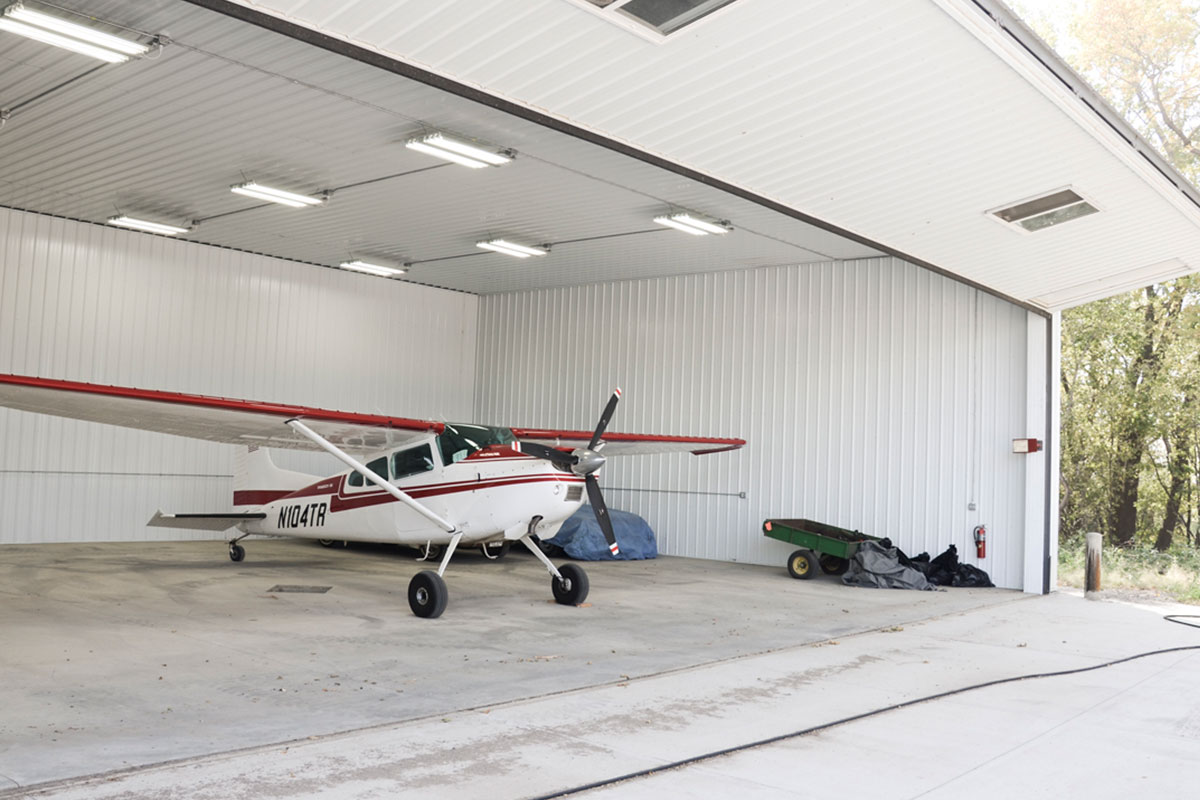
General aviation and maintenance hangars trade the heavy security of the terminal for a more demanding building. A high-bay hangar with a wide clear-span roof, whether wide-flange steel or a pre-engineered metal building, generates significant wind uplift and thermal movement across a long span, and the fastening pattern and seam geometry have to be designed for it. Standing seam metal is often the right system on these structures, and we specify and install it across the Little Rock aviation market with attention to the uplift and movement characteristics that define hangar roofs.
Airside and secure-area work requires badged, credentialed crew and full coordination with airfield operations, and we treat that as a baseline rather than a hurdle. Material deliveries, crane picks, and any work near airside areas are scheduled into approved windows and coordinated through the NOTAM process where required. We do not put a crew member into a secure or airside zone without confirmed authorization, and we carry the credentialing timeline in the bid schedule so it never becomes a mid-project delay.
Planning Questions
What decides the right airport terminal & aviation facility roofing path?
The roof assembly, leak history, drainage, access, rooftop equipment, and operating risk below the roof all shape the recommendation.
Can work be phased around occupied spaces?
Yes. The scope should identify tenant-sensitive areas, daily dry-in expectations, access routes, and weather limits before production starts.
What documentation should ownership expect?
Photo records, repair notes, roof-area observations, product information when applicable, and a clear summary of remaining roof risks.