
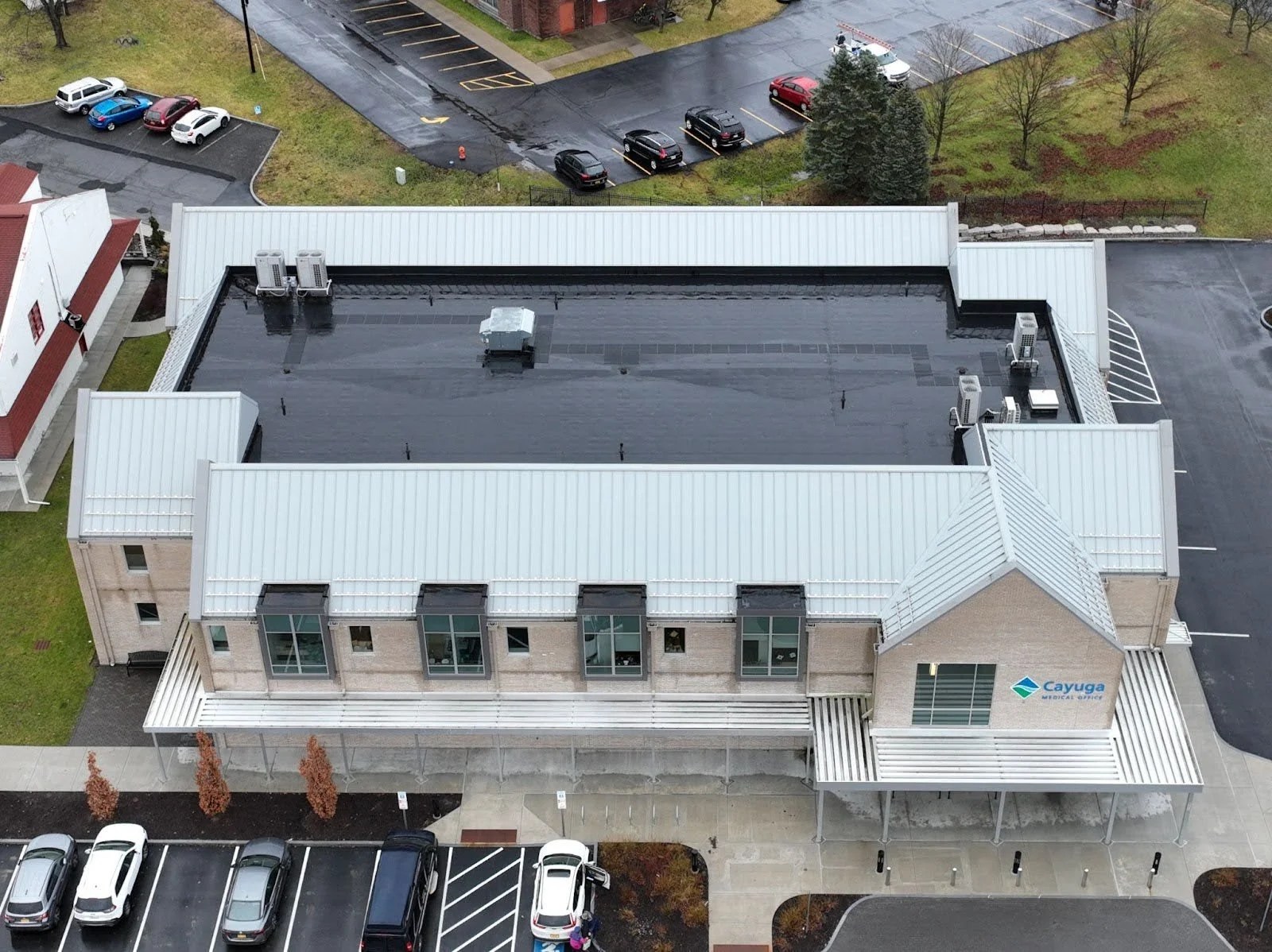
Healthcare Facility Roofing work starts with verified roof conditions, clear repair limits, and a practical decision path for the building owner.
Healthcare Facility Roofing roof scope
Baptist Health Medical Center in Little Rock, the flagship hospital of the Baptist Health system and one of the largest medical facilities in Arkansas, operates a campus that encompasses multiple patient towers, medical office buildings, surgical suites, and clinical support facilities whose roofing systems must perform without failure in a building that never reduces its operational tempo. Commercial healthcare roofing at Baptist Health and throughout the Little Rock medical community requires protocols, technical specifications, and a contractor mindset fundamentally different from standard commercial flat-roof work, because in a hospital, roofing failure is not just a property issue: it is a patient care event.
Continuous occupancy governs every decision on a Little Rock hospital roofing project. Baptist Health's patient towers, ICUs, surgical suites, and labor and delivery units operate 24 hours a day, 365 days per year. Construction activity overhead, noise, vibration, HVAC disruption, debris, must be controlled to protect patients who cannot be moved and clinical staff who cannot be distracted. We develop pre-construction plans that identify every occupied space below the roofing scope, establish area-specific operational constraints, and sequence work to keep all active patient care areas within the noise and vibration thresholds appropriate for their clinical function throughout the project.
ICRA protocol compliance is a non-negotiable requirement for roofing work on any Little Rock hospital campus. Baptist Health's infection control committee, in coordination with The Joint Commission's Environment of Care standards, establishes the ICRA classification for construction activities and specifies the containment, filtration, and debris management requirements that apply to each work zone. Roofing tear-off above patient care areas typically triggers a Class III or Class IV ICRA classification, requiring negative air pressure containment, HEPA air filtration, and strict debris management procedures. We obtain required ICRA permits before mobilization and maintain compliant conditions throughout each project phase.
Outdoor air intake protection is a critical infection control responsibility during roofing work at Baptist Health. Tear-off of existing roofing generates fungal spores, dust, and biological contaminants that can compromise the sterile air quality required in patient rooms, surgical suites, and ICUs if they infiltrate the building's outdoor air intake system. We map all outdoor air intakes on the campus roof before specification, coordinate with Baptist Health's facilities engineering team to identify which intakes serve patient care areas, and establish intake protection or bypass protocols that prevent contamination of the air handling system during construction operations.
Penetration management on the Baptist Health campus roofs reflects decades of infrastructure additions. Medical campuses accumulate HVAC equipment, exhaust fans, medical gas vents, emergency generator stacks, emergency communications masts, and utility penetrations at a density that makes hospital roofing look like an obstacle course compared to ordinary commercial work. We catalogue every penetration on a hospital roof before specification, evaluate existing flashing conditions, and produce individual detail drawings for every non-standard condition before new membrane is ordered. Leaving compromised penetration flashings under a new membrane on a hospital project is professionally unacceptable regardless of schedule pressure.
Arkansas weather considerations add complexity to Baptist Health roofing work. Severe spring storms, hail, high-wind events, tornadoes, are a real risk during Little Rock's April through June season, which overlaps with many healthcare roofing project windows. We maintain storm response protocols on all active hospital projects that include emergency communication channels with facilities staff, rapid site-securing procedures when storm warnings are issued, and post-event inspection protocols that confirm watertight conditions before work resumes and that document any storm-related damage for the hospital's property insurance records.
Sterile environment maintenance during roofing work extends to managing fumes and odors from roofing adhesives, primers, and hot-applied materials. Some healthcare occupancies, particularly neonatal ICUs, oncology units, and pulmonary care areas, are acutely sensitive to chemical odors and volatile organic compounds. We review HVAC intake configurations before specifying adhesive products and select low-VOC water-based formulations wherever fume-sensitive occupancies are within range of the work zone. When solvent-based products are necessary for performance reasons, we schedule their application for periods when the building's HVAC system is operating in a configuration that minimizes fume introduction to the interior air stream.
Planning Questions
What decides the right healthcare facility roofing path?
The roof assembly, leak history, drainage, access, rooftop equipment, and operating risk below the roof all shape the recommendation.
Can work be phased around occupied spaces?
Yes. The scope should identify tenant-sensitive areas, daily dry-in expectations, access routes, and weather limits before production starts.
What documentation should ownership expect?
Photo records, repair notes, roof-area observations, product information when applicable, and a clear summary of remaining roof risks.